Thursday, May 29, 2014

STORY IDEAS

by David Heilwagen

Story ideas, it seems, can pop into your head when you least expect them. Think back for a moment. How many times have you been riding in a crowded subway, or driving along the freeway in the middle of rush hour traffic, when a burst of inspiration picks that exact moment to dance through your brain? It’s more than likely happened to all of us at one time or another.

More than once I have woken-up in the middle of the night from a dream, my subconscious having just mapped-out a plotline for my next great novel. Regrettably, I rolled over and went back to sleep, thinking I would remember it in the morning. That never happened. Although I could recall having the dream, for the life of me I couldn’t recollect the nuts and bolts of what had taken place inside my head. Another great story forever vanished.

Unfortunately, great storylines are oftentimes fleeting, and if you don’t capture them at the exact moment they appear, or soon thereafter, there’s a strong chance they will be forever lost.

As a writer, it’s always a good idea to have a way of recording these thoughts close at hand. It doesn’t have to be anything fancy or high tech. For example, it can be as simple as a yellow legal pad and a pencil next to your bed, or a small recording device stuck in your pocket. With today’s advances in electronic technology, you can easily document ideas, dialogue, scenes, characters, etc, onto an iPhone or any other device, and then store it for later use. I’ve even typed-out the idea into text message and then sent it to my email address. That way I can pull up the email once I’m back in the confines of my writing workspace.

In the days before cell phones and iPads, how many times did you see famed writer, David E. Kelly, walking the red carpet at the Oscars with a pen and yellow legal pad in hand. That’s dedication to your craft, folks. Ernest Hemingway, for example, used tiny notebooks bound with elastic bands called Moleskines. They were small enough that he could keep one in his pocket while out on the ocean in his fishing boat, Pilar. You can still purchase these handy little notebooks at almost any office supply outlet or college bookstore. If modern technology is your thing, there is an app available for your phone called, A Novel Idea.

Whatever method works best for you, make sure you get those ideas down as soon as you can. Who knows, you may just be mapping-out your next bestseller.

Fleeing a violent husband and a dying marriage, Amanda Brougher abandons her life in Nashville. Driving through the night, she eventually lands in Key West, Florida. It’s here Amanda hopes to find the tranquility needed to restart her life managing a small island inn. But Amanda’s plans begin to unravel almost as soon as she arrives. 
Paul Brougher isn’t about to let his wife leave so easily. As soon as he discovers she’s left, Paul embarks on a deluded quest to hunt her down. Plus, the inn’s elderly owner has died unexpectedly, leaving Amanda now without a job or a place to live. Her son, Brock Hamilton, is putting the inn up for sale. A veteran U.S. Coast Guard Officer, Brock is trying to come to terms with his own shattered past. Now, with a major hurricane barreling towards Key West, and a deranged ex-husband quickly closing-in, two lost souls turn to each other for comfort and security. A spark ignites and the flames of romance quickly consume them, setting into motion a chain of events that takes both of them on a life-changing journey of danger, intrigue, and self-discovery.

David Heilwagen survived nearly 30 years as a police officer on the streets of Indianapolis. He retired in 2008 with the rank of Sergeant. Out of his love of reading and writing fiction came his first book, Cone of Uncertainty. David grew up in the Indianapolis suburbs of Lawrence, Indiana; graduating from Lawrence Central High School. He studied at Vincennes University and the Indiana University School of Journalism. He has written and published several travel articles on the Florida Keys, as well as hiking and snowshoeing in Colorado. David lives on the Southside of Indianapolis with his wife, Julie, and daughter, Tara. When Indiana turns cold, David can be found on his sailing vessel, Wind Bandit, cruising somewhere in the Florida Keys. 

You can reach David at: https://www.facebook.com/pages/Cone-of-Uncertainty-A-Key-West-Romantic-Thriller/265218636915029

Thursday, May 22, 2014

Seven Years to the Bookshelf

In 2007, I finally decided to sit down and begin writing a novel. I had been a voracious reader since I was a teenager, enjoying the terrific stories penned by James Clavell, Tom Clancy, Clive Cussler, and Robert Ludlum. In fact, I lost count of how many times during my high school years I re-read some of the books in Clavell’s Asian Saga (Tai-Pan & Noble House) in English class, rather than listen to another lecture on diagramming sentence structure or a discussion of a Shakespeare comedy.

During those years, my mother introduced me to Robert Ludlum’s books, and I particularly enjoyed his Bourne Identity and Parsifal Mosiac, which initially fueled my interest in espionage thrillers. Following closely on the heels of that discovery, I began to read Clive Cussler’s Dirk Pitt adventures.  My first exposure to the techno-thriller came from the man who founded the genre.  I found Tom Clancy’s Hunt for Red October on the shelf in my high school library, and by the time I’d finished his second book, Red Storm Rising, I was hooked.

Looking back on all those terrific stories, I was impressed not just by the story telling abilities of all those great authors, but also by the magnificent imaginations and sense of ‘world control’ that being an author conveys. You create a world or a universe, populate it with interesting characters, bring them into conflict, and determine how it will work out. Then you write a story that you hope others will enjoy and identify with.

Following the 9/11 attacks, I took note (and great exception) to some of the mischaracterizations and misinformation thrown around in the media about modern military capabilities and the professionalism of the members of the intelligence community. Being a veteran of the modern military and an experienced intelligence professional, my understanding was admittedly not shared by the larger public.

After due consideration, I decided it was time to put my fingers on the home row, and begin crafting a novel to give the reader a sense of being an intelligence professional and be in the field and ‘on the trigger’ with the special operations forces. It took me nearly a year to complete it, and as I worked, I also began to read everything I could find about writing novels to improve my technical skills (since I had only taken one creative writing class in college).  The books on writing also covered an overview of the book acquisition and publishing process; so I branched out, buying more books to learn about the business of publishing so I could interact effectively with my future agent and editor.

While I enjoyed building my ‘world’ within the novel and crafting what I hoped would be an enjoyable thrill ride, I also made a conscious choice to follow the traditional publishing route – find an agent to represent my work, and let my agent find a publisher.  At the time, self-publishing seemed a very murky prospect (and still does to my mind), and e-books were not yet the healthy chunk of sales they are now.

Once the manuscript was complete, I began querying agents for my genre. I did so with the same hope I suspect all writers share – I’ll get one after the first few queries. After a few months, I had experienced the first six of many rejections. Persistence, diligent searches for agents representing my genre, and the submission of effective queries (and, I think some luck) finally resulted in an offer of representation from a publishing professional just starting his own agency.

Then it was time for more rejections. My agent and I spoke monthly. He updated me on his queries to publishers, and their ‘it’s not right for our list’ vanilla rejections as the bad economy and the advent of e-books made impacts on the decision to invest in launching a new author. Patience became the watchword as the years crawled by.

Then, in late 2012, I received an early Christmas present – an offer from Turner Publishing for not just my first novel, but my second as well. Interacting with the staff at the publishing house is another exercise in patience.  Throughout the months leading up to the street date, it’s important to remember two things - your book isn’t the only one the staff is working on; and that the editing process requires that your ‘pride of authorship’ be throttled back - alot.  In the end, the editorial staff wants to make your book the best possible saleable property, from cover art to story, and that benefits you as much as the publisher.

With a street date set for the first novel in June of 2014, and the second in September, most of 2013 was another year to practice being patient, and finally, in October, a late birthday present – the cover art for THE INHERITOR and the first really tangible evidence that I would finally be a published writer.  Since then, the months have slid by in story edits, copyedits, marketing and publicity discussions, and plans for the first book signing.

Overall, while it has been long in coming, it has been an adventure so far.  Looking out over what will be my debut year, I’m sure it will be interesting and exciting in many ways.  Hopefully, the stories I’ve written will be enjoyed by my readers. After all, that is what matters most to a writer.

* * * 
Tom Wither served his country for more than 25 years as a member of the Air Force's Intelligence, Surveillance, and Reconnaissance Agency and its predecessor organizations, the Air Intelligence Agency, the Air Force Intelligence Command, and the Electronic Security Command. He has served as an intelligence analyst at various locations, including Japan and Saudi Arabia, and is a veteran of the Persian Gulf War. During Operation DESERT SHIELD, he was selected to brief HRH Prince Charles, the Prince of Wales; the Commanders of British and French in theater forces; and the U.S. Army's VII Corps Commander on the integration of Air Force intelligence capabilities within the Tactical Air Operations Center. During Operation DESERT STORM, he provided time critical information to the Joint Rescue Coordination Center resulting in the safe extraction of downed allied airborne personnel and the provision of location data to the USCENTCOM targeting cell that culminated in the destruction of 25 strategic targets. He has received the Meritorious Service Medal, three Air Force Commendation Medals, and three Air Force Achievement Medals. In addition to his MS in Computer Systems Management, Tom holds professional certifications from the National Security Agency as an Intelligence Analyst, and the Director of National Intelligence as an Intelligence Community Officer (now the Joint Duty program). He lives near Baltimore.
You can contact Tom via:  www.TomWither.com; or on Facebook: Tom Wither - Writer

America’s Most Deadly Enemy is still loose . . . and he’s ready to move. Following his dead mentor’s desire to re-establish the Islamic Caliphate, Aziz Abdul Muhammad, hand-picked by bin Laden himself, masterminds a series of attacks on the U.S. energy infrastructure that will reignite the war against the West. As his initial series of attacks creates mass panic, leaving the Northeast and Mid-Atlantic states in terrified darkness, the manhunt is on.  In a unique special operations force, veteran intelligence officer David Cain, along with Air Force Sergeant Emily Thompson and rookie FBI Agent Dave Johnson, leads the U.S. effort to find Aziz and his operations expert. From Camp Delta in Guantanamo Bay to Chicago and the outskirts of Tehran, the force must halt Al Qaeda’s attempt to rise from the ashes of its former self—and stop The Inheritor before the rest of his terrifying plan unfolds. Wither blends his extensive military intelligence experience with fast-paced storytelling to create a gripping thriller that spans six weeks and four countries. 

Thursday, May 15, 2014

Confessions of a Writer

by Terry Irving


When I graduated from college, I was certain of a few things about my future.

* I was never going to live long enough to get Social Security.
* I was never going to live in Washington DC.
* I’d just escaped a family helmed by an alcoholic so I was never going to be tied down by marriage and kids.
* I was going to travel the world on my own—probably by tramp steamer--and
* I was never going to be a writer.

So what happened?

* I’m now 62 and taking early benefits,
* I’ve always lived near Washington because I keep marrying women who refuse to leave.
* I spent two weeks all alone in France with money in my pocket and complete freedom. I was miserable.
* In the year I turned 33, we had a baby, paid cash to put a kid through college, and bought a house out in the suburbs. I learned how to scream right back at debt collectors.
* It's all a story of broken dreams but the worst thing is that I'm becoming a writer.

How did this happen? When I was a young kid running around ABC News, I told one producer that I couldn't be a writer because then I'd have to compete with my father. He looked at me and said, "My old man was known to write a thing or two and I still manage to pound out copy." His name was Tom Capra. Yeah. Frank Capra of A Wonderful Life and Why We Fight was his dad.

I managed to avoid writing for about 20 years. I was a television producer and that meant solving problems—anything from waking a drunken cameraman to carrying $77,000 in cash into Beirut. I edited scripts, organized them, did the interviews, and found the video but I always had the reporter write it.

So, how did I begin to write?

After I ventured out of ABC and into the real world, I realized that most people will do anything to get out of writing. Drawn by higher freelance rates, I fell into the wretched habit. First, it was light stuff like documentaries on Croatia and instructional videos on the proper storage of explosives, but I soon worked up to hard core--the first (and only) History of the World on CD-ROM and users manuals for video editors and pay-per-view software.

I knew it was too late when I began writing for anchors and correspondents, pounding out heartfelt obituaries for people I didn't know, and creating dramatic descriptions of wars a world away. Most of my teachers used the CBS Method (they would throw the copy at me and scream, "You call this a script?") so I learned quickly. The day I knew I was doomed was when I had ten minutes to knock out something dramatic and there wasn't a word in my head. I just sat down put my fingers on the keys.

It worked.

I've always been fired a lot—it's a package deal with my personality—so I wasn't very surprised to find myself at home in 2010. What was different was that I was old. I swear it snuck up on me when I wasn't looking. After 9 months of futile phone calls and lunch dates, I decided to write a book that had been in the back of my mind since 1976.

The nice thing about the way I was trained is that you learn to write really fast. The first 70,000-word draft was done in 12 weeks—and several of those weeks, I was writing for Retirement Living Television during the day. The soul-deadening experience of writing promos ("Watch tonight's show or your children will die,") made those begging letters to agents a snap. I got an agent and then a new job came along and I forgot the book. I felt bad about that but these people were actually paying me.

When, inevitably, I was fired from that job, I knew it was crunch time. Not only was I far too old to hire but most people in Washington now knew I was a "difficult" person to work with.

Sadly, I agree with them on both points.

After I was sent home from Lyft.com for failing the mandatory fist-bump, writing was all that was left. I picked up that first manuscript, completely rewrote it, and my agent managed to sell it to an insane Englishman who was clearly drunk at the time. Encouraged by this "instant" success, I knocked out an eBook about unemployment and instantly lost all faith in the low-cost, high-profit world of online publishing. I managed to get some real money for editing someone else's book, then it was turning the first novel into a screenplay just in case Hollywood calls (it hasn't,) and wrapping up the sequel seven months early. Then I knocked out a paranormal detective thriller. Why? Because I can't quite bring myself to write Women Who Love Werewolves and the Vampires Who Love Them.

That was my first year as a writer.

I have a series about a Greek-American private eye in 1930s Manila on the back burner, the third book in the Freelancer Series to work out and, oh yeah, a publicity tour to try and sell the first book. I just went to a writer's conference where the entire panel agreed that no one should quit their day job in the hope of making it as a writer.

I wish I had that luxury.

On the other hand, I've known times where I had less money and more debts; I like sitting around in jeans and a Hawaiian shirt, and a few of the people I trust have said that my work doesn't actually suck. So what if the situation is basically "Write or Die"? It just makes it a bit more challenging.

All the tramp steamers have been replaced by container ships anyway.

In his debut novel, Courier, Emmy award-winning journalist and  writer  Terry Irving paints a gritty picture of a Washington DC that today has completely disappeared under new parks and high-rise office buildings. In the middle of the scandal and drama of Watergate,  Rick, a motorcycle courier, unsuspectingly picks up a roll of news film and—after the correspondent  and crew are killed—finds that he is next on the killer’s to-do list. With the help of friends—and a  woman who threatens to crack the shell he's built to defend his heart—Rick must discover what's on the  film and why officials are willing to kill to keep it from the front pages.

Author and long-time journalist  Terry Irving  moved to Washington D.C. in 1973 to kick around for a few weeks and never looked back. In the nation’s capital, Irving started out riding a classic BMW for ABC News during Watergate. Carrying that news film was the beginning of a  40-year career  that has included producing Emmy Award-winning television news, writing everything from magazine articles to standup comedy and developing early forms of online media. He has traveled and worked in all 50 states plus parts of Europe, Africa and Asia.  Irving is the winner of four National Emmy Awards, multiple Peabody, DuPont and Telly awards, plus an honor at the Columbus Film Festival. He has produced stories around the world from the fall of the Berlin Wall to Tiananmen Square. He worked as a senior live control room producer at  CNN, Fox, ABC and MSNBC He has written and edited copy for some of the top anchors and journalists in television news including Diane Sawyer, Wolf Blitzer, and Ted Koppel.

Thursday, May 8, 2014

Second Novel-itis

by Jenny Milchman

The Thrill Begins and the Debut Authors Program is all about that first magical book release, something many of us labor towards for five, ten, fifteen years. (It took me thirteen…and my debut novel was the eighth one I had written).

But what gets focused on less is what happens after that. There is no Sophomore Authors Program (though maybe there should be). Is it true that the only thing harder than getting a first novel published is building a lasting career as an author? How do we stay in this game? And how do things differ between year one and year two?

I thought I would present some of the events and activities that surround a book release, and the differences I’ve seen between my first time and this one.

Day before pub:
*First Novel: I sit cross-legged on my bed and chew my nails. What is tomorrow going to be like? Make that, what the %@#!! is tomorrow going to be like?
*Second Novel: I have a hometown book party. My publisher is willing to release books a day early so I can fit this in. Would they have done this last year with my debut? I don’t know the answer to that, but I do know I wouldn’t have had the courage (or knowledge) to ask.

Pub Day:
*First Novel: I celebrate with a launch party at New York City’s last and greatest mystery bookstore, The Mysterious Bookshop in Soho. Before going downtown, I stop off at my publisher to sign books, which they will send all over the country. I routinely pinch myself and think, I am a real author at last. (Sometimes I even say this out loud). The store is packed. People eat and drink. I say words I can’t remember, though I do know I thanked a famous author who was kind enough to give me a blurb. I read a section out loud. It’s the first time I’ve ever read aloud when I am not tucking a child into bed.
*Second Novel: I am lucky enough to celebrate pub day with a launch party at The Mysterious Bookshop again. This time around, I am joined by an author who just happens to be an ITW member, MJ Rose, making for an even more vibrant, fun event. And guess what? The author I thanked so heartily last year around this time? He is out there in the crowd, mingling with his many adoring peeps.

Blog Tour & Online Presence:
*First Novel: I have some FB friends and have just arrived on Twitter. My presence on social media is sporadic, although I am always happy to read other people’s status updates and thank them for noticing mine. Twitter I don’t get at all. I write novels. What can be said in 140 characters? The independent publicity firm I hired put together a dense and exciting blog tour, front-loaded to saturate the web (as much as such a thing is possible) around the time of release. I am frantically writing and commenting and completing interviews during this time.
*Second novel: My FB friends are up to 3000 and I have 2000 Twitter followers. I now see what can be done in 140 characters. (Not much, but still somehow I feel compelled to do it). I spend two or three hours per day on these sites, and the world feels like a smaller, friendlier place. This time around, I spread out the blog appearances so that they keep time with my face-to-face appearances (more on this to come). I’m no less frantic as I write and fill out and answer interview questions—just how are we supposed to do this all again?—but the posts appear with more time between, giving me a chance to catch up on comments. Hopefully they will also keep news of the book and my travels out there in cyber space, but I’ll have to let you know about that next year.

Other media:
*First novel: My fantastic independent publicity firm (shout out—JKS Communications!) got me onto local TV morning segments and multiple interesting radio shows. I spent the first 6 weeks after release feeling a little like a movie star.
*Second Novel: I’m focusing on radio shows where I really connect with the host (shout out—Pam Stack and Authors on the Air) and which air in cities and states where I’ll be doing events (shout out—the Culture Buzz in Des Moines, Iowa). I won’t be doing TV segments because the early hour makes them difficult to schedule—unless your brilliant independent publicists take care of this—and also, I’m not convinced that TV really helps authors connect with readers until the author is very well established.

Book Tour:
*First novel: My debut released in January, and my family and I went out on a 7 month/35,000 mile book tour. I’ve written about this a lot elsewhere, so right now I will just say that the trip was magical enough—and hopefully successful enough—that this time around…
*Second Novel: My publisher has put together a tour for me as far west as Chicago. After that I’ll continue on for 4 months/20,000 miles with my family (the shorter length is an artifact of pub date, not because the first was too long). Also another ITW author will come along for the first 2000 miles. (Shout out—Carla Buckley!) How did that happen? Stay tuned. I just may write about it. Hey, you can always cram in another blog post during the busy first months after release…
                                                              
Liz Daniels has just set off on what should be a long-awaited vacation, but when the family stops for the night, she wakes to find a terrifying reality. Her children are missing, and the hours tick by without anyone finding a trace of them. But in a sudden, gut-wrenching instant, Liz realizes that no stranger invaded their hotel room. Instead, someone she trusted completely has betrayed her. Now Liz will stop at nothing to get her children back. From her guarded in-laws’ farmhouse to the woods of her hometown, Liz follows the threads of a terrible secret to uncover a hidden world created from dreams and haunted by nightmares.
Jenny Milchman's journey to publication took thirteen years, after which she hit the road for seven months with her family on what Shelf Awareness called "the world's longest book tour". Her debut novel, Cover of Snow, was chosen as an Indie Next and Target Pick, praised by the New York Times and San Francisco Journal of Books, given the Mary Higgins Clark award, and nominated for a Barry. Jenny is also the founder of Take Your Child to a Bookstore Day and chair of International Thriller Writers' Debut Authors Program. Jenny's second novel, Ruin Falls, just came out, and she and her family are back on the road.

Thursday, May 1, 2014

May Debut Releases

It's the first Thursday in May, which means debut releases. Please take a look and let’s celebrate their success!


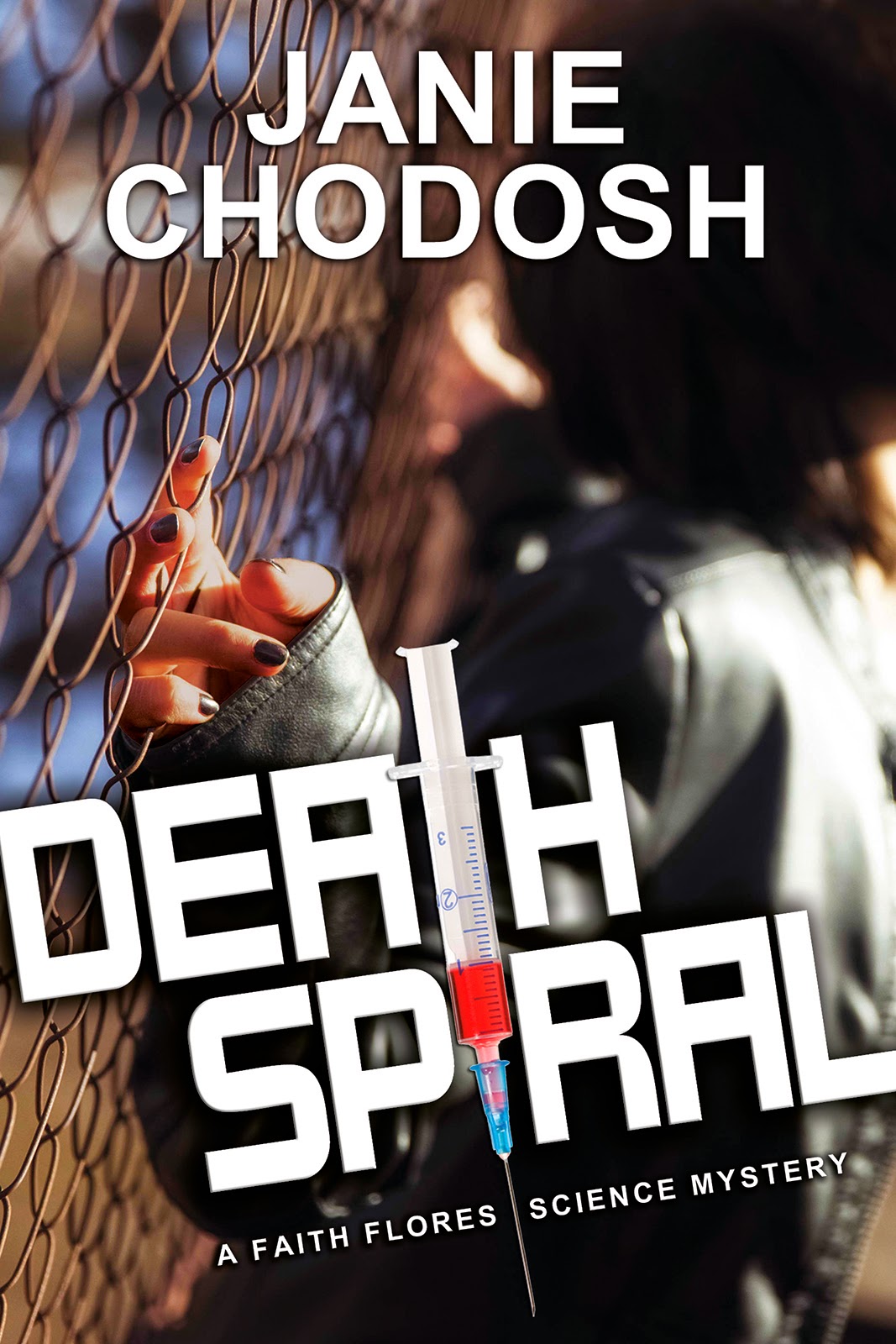
Janie Chodosh - Death Spiral (The Poisoned Pencil) April 1, 2014
www.janiechodosh.com

When loner Faith Flores finds her mother dead of an apparent overdose, she refuses to believe that’s the case. Sure, her mom made some bad decisions, but leaving her daughter would never be one of them. Unfortunately, the cops are all too eager to close the case and move on, sending a distraught and unsatisfied Faith to live with her Aunt T in the suburbs of Philadelphia. 

But a note from Melinda, her mom’s junkie friend, prompts Faith to begin digging, igniting her passion in science and her need for answers. Faith soon discovers Melinda and her mother had participated in an experimental clinical trial to treat heroin addiction. Then Melinda also turns up dead from an apparent overdose. Now Faith is pulling out all the stops in her search for truth, cutting school, lying to her aunt, her best friend, even the police. The only person she can’t lie to is new boy Jesse, whose brutal honesty is a welcome respite from the mountain of misinformation uncovered by her investigation. 

Faith’s investigation takes her through the myriad back alleys and laboratories of Philly, all the way to one of the most powerful scientists in town. But when the medical examiner’s body is found in the Schuylkill River, Faith realizes if she doesn’t find who’s behind the sinister science and its cover-up, she could be next.


Dennis Hetzel - Killing the Curse May 2014

Even the President must try to stop a fan bent on making sure the Cubs win the Series.


Gary Kriss -The Zodiac Deception ( Forge Books) May 6, 2014

Summer, 1942: The con man known as David Walker didn't exactly volunteer, but OSS chief Wild Bill Donovan convinced him that serving his country and the cause of freedom by posing as German astrologer Peter Kepler was a better use of his time than going to prison for impersonating a Princeton University professor. His mission: use his skills in illusion, sleight of hand and deception to gain Heinrich Himmler’s trust and persuade him to assassinate Adolph Hitler.

In a plot that involves German resistance members in high places, Walker walks a tightrope of deceit, playing on the high command's fascination with the occult to penetrate the highest levels of Nazi power in a daring plan to eliminate the Nazi Führer.

Thursday, April 24, 2014

The Art of Resurrection

by Elle Cosimano

It wasn’t a body I’d dumped. Not really. 

More like a slippery mass of heart and guts that I delivered in the form of an 85,000-word manuscript with a query letter.

“You write passionately, with a lot of heart,” my soon-to-be agent said right before she signed me as her client. “You’ve got the makings of a great hook and a hot romance here. But the plot is weak, and the mystery isn’t really a mystery at all.”

She was right.

So with rigid determination, I set out to give it structure. I tinkered with the story until the skeleton of a strong plot took shape, then preserved and tucked the fragile heart of my book safely under its ribs.

“Now you’ve got the heart, and you’ve got the plot, but you’re writing a thriller. And it isn’t scary enough,” she said. Then she added in a stern, mothering tone. “Elle, someone has to die.”

And again (and as always) she was right.

So I toughened up. Pushed my way past all the inner and outer voices that held the reins on my story. I let go of my fears of what people would think… would it be too dark? Would it be too scary? I let go and I ran toward the darkness instead of skirting the edge of it like a coward. 

And when I returned from that journey, the thin, fragile body I’d left lying on my agent’s desk had muscle! It had legs to stand on! It had filled out into some living, breathing thing. It was terrifying, and I loved it!

All it needed was a bit of fleshing out. A little character arc-rounding here. A little backstory-filling there. A little shaping and definition, and… viola! 

I’d finally dumped a body -- a real mystery – into my agent’s trusting hands.

And what I learned from the process was this.

The best stories – the ones with the power to move us -- aren’t left in a basket on our front porch, a cooing, babbling bundle of joy. They’re constructed from messy parts, bits and pieces collected from roadsides and dark alleys and gutters, reassembled in some Frankensteinian laboratory of the mind. They’re re-constructed, over and over again. They have stitches and scars. We bleed for them.

Your story may feel broken. It may feel, at times, like it can never be fixed.  But if the guts are there, the rest can be built (and re-built) around them as long as the laboratory is open.


Elle Cosimano is the daughter of a prison warden and an elementary school teacher who rode a Harley. She majored in Psychology at St. Mary's College of Maryland and set set aside a successful real-estate career to pursue writing. She lives with her husband and two young sons, and divides her time between her home near Washington, DC and a jungle tree house in the Mayan Riviera.

Nearly Boswell knows how to keep secrets. Living in a DC trailer park, she knows better than to share anything that would make her a target with her classmates. Like her mother's job as an exotic dancer, her obsession with the personal ads, and especially the emotions she can taste when she brushes against someone's skin. But when a serial killer goes on a killing spree and starts attacking students, leaving cryptic ads in the newspaper that only Nearly can decipher, she confides in the one person she shouldn't trust: the new guy at school--a reformed bad boy working undercover for the police, doing surveillance. . . on her. Nearly might be the one person who can put all the clues together, and if she doesn't figure it all out soon--she'll be next. www.nearlygonebooks.com


Thursday, April 17, 2014

My Misadventures in Research


By Robert Liparulo

Solid research is crucial to the success of any story. You’ve heard it a thousand times (see Brad Taylor’s excellent article on "The Thrill Begins": How Important is Research in a Novel?), so I won’t belabor the point.  But maybe airing my more unusual research-related experiences will embolden your own efforts to dig deep for the “good stuff” that’ll lift your stories from good to great. None of this is meant to scare you, but rather show you that you can step on toes (albeit unintentionally) in the name of research and live to tell about it.

Know when you have enough. The best knowledge comes from personal experience, but when your story extends beyond that, you have to reach out to others. My typical tactic is to first talk to someone I already know who can point me to someone else with more knowledge of the subject I’m researching. With luck, that person will in turn refer me to another source with even more knowledge . . . and so on, until I reach the person who can give me the juiciest bits. This is the person who knows not only the truth, but also the fascinating factoids that no one will find in a magazine or Wikipedia article, the stuff that gives your voice authority and supports your story’s contentions like iron scaffolding.

For my first book, Comes a Horseman, I wanted to learn more about a rumored organization that was hording financial assets and human resources in order to turn them over to the antichrist once he revealed himself. I contacted a friend at the Denver Seminary and got the ball rolling toward the All Knowing Oz. I never reached him or her. Just when I thought I’d really stumbled onto something—people I believed were on the fringes of the very group I sought—a phone call woke me at three in the morning.

The person on the other end was using an electronic voice changer: “Stop looking for us,” was all the voice said, and it was enough. I decided instantly that I had all I needed to tell my story, and not wanting to find my dog nailed to my front door, I stopped digging. But a character in the story did receive a late-night call and felt the same gut-liquefying terror I did upon hearing an electronically altered voice coming over the line.

Inquisitiveness begets inquisitiveness. For my next novel, Germ, I contacted an engineer at Lawrence Livermore National Laboratory, which had invented the Lifeguard, a technology that tracked bullets in flight and accurately returned sniper fire within milliseconds of a shot. I wanted to know if the system could be paired with a M134 minigun—a Gatling-style machine gun that can fire 6,000 rounds a minute—and where the technology would be in a few years; being ahead of curve makes stories informative and just-plain-cool. The engineer provided invaluable insight into the technology, but insisted on my not acknowledging him in the book, almost always a great sign you’ve uncovered true insider information.

About a week later, two FBI agents came to my door with questions of their own, all pertaining to my interest in the Lifeguard system. They left with copies of my story notes, my book contract, and Comes a Horseman. That was the last I heard from them, but knowing you’re on the FBI’s radar is a bit unnerving.

Being in the wrong place at the wrong time. While researching The 13th Tribe, which tracked a group of immortal vigilantes as they traversed the globe doing what vigilantes do, I contacted an owner of a travel agency that specialized in both international travel and private jet rentals. I needed to know about small, private airfields in places like Tel Aviv and Bucharest. Next thing I know, the local PD’s knocking, but not to find out if I was an international terrorist or assassin. Shortly after my visit, the travel agency had been broken into and robbed; the owner labeled me as a “suspicious character.” Again, I showed the investigators my notes and contracts, my published books and current manuscript, and gave them my fingerprints. Turns out the owner was indicted for the crime; I was his red herring. There’s a story in that, but I haven’t done anything with it—yet.

The cautionary tales go on and on—the black-market wolf-dog breeder who tossed a steak into a pack of hungry animals while telling me, “No one would be stupid enough to turn me in”; the call from the NSA wondering why I wanted to know about satellite laser weapons (it was for my book Deadfall)—and in every case, the research and how it played out in my story was worth the scare and hassle. I write thrillers; rattling cages comes with the territory, and if I’m not rattling them enough to get some blowback—that’s when I’m really worried.

Best-selling novelist Robert Liparulo is a former journalist, with over a thousand articles and multiple writing awards to his name. His first three critically acclaimed thrillers—Comes a Horseman, Germ, and Deadfall—were optioned by Hollywood producers, as well as his Dreamhouse Kings series for young adults. His latest book is The Judgment Stone, the second in the Immortal Files trilogy, after The 13thTribe. Liparulo is currently working on an original screenplay of a political thriller with director Andrew Davis (The Fugitive, The Guardian). New York Times best-selling author Steve Berry calls Liparulo’s writing “Inventive, suspenseful, and highly entertaining . . . Robert Liparulo is a storyteller, pure and simple.” Liparulo lives in Colorado with his family.
The Judgment Stone  finds  The 13th Tribe's Jagger Baird facing a group of Immortals even nastier than the Tribe. When this group uses an ancient artifact, which allows them to see beyond the veil of this world into the next, to murder the world's most gifted people, Jagger must overcome his own doubts and fears to stop the carnage.

Thursday, April 10, 2014

The editor is my friend... right?

by Annie Hauxwell        

Remember the scorpion and the frog? The scorpion persuades the frog to give him a ride across the stream, arguing he won’t use his sting because if he did he would also die. 
Halfway across the scorpion stings the frog. The frog asks “why?”, to which the scorpion answers “Because it’s in my nature.” Glug glug glug.
An editor also has a certain inescapable nature. They may like you. You may like them. But if they’re good at what they do they won’t pull their punches when it comes to your work. Your affection may evaporate as you feel the sting.
The debut author may receive a handful of general queries about their manuscript or a full-blown, marked-up re-structure (characterized as ‘suggestions’). In whatever form, your first edit will be scary. It doesn’t necessarily have to be fatal.
My first book was published in 2011 and I didn’t understand any of this; it never occurred to me to ask what approach the editor would take, because I didn’t realise there was more than one. Now I know better.  
My third book is due out in July. I’ve now worked with three editors on two continents; smart, experienced and charming people. Two editors (different publishers) worked on my third book. The notes I received differed substantially in form and content. An embarrassment of riches which at times became a curse of abundance. 
But nevertheless a revelation: not all editors use the same approach. There isn’t one right way and this variation in method can be truly enlightening if you can get them to talk about what they actually do and why.  
What happens when your editors disagree or when you disagree with your editor? First, ask yourself if they’re right; often they are and this is why deep down we love ‘em: they stop you from making a fool of yourself.
But what if you think they’re wrong? Will you deny the many-headed Cerberus employed by the gargantuan publishing house on which your future depends? You have a two-book contract and would love to sign another. Dare you cross them? Do you want to be known as a difficult author?
This is where the egotistical self-belief that sustained you through long, cold nights of solitary labor comes in handy: just say no. It may be hard to believe, but seeing your book in the bookshop will be cold comfort if it is not the book you wrote.
Of course, if it turns out to be a best-seller you may learn to live with the pain. But remember the frog. Glug glug glut.

Annie Hauxwell was born and raised in London. Her family emigrated to Australia when she was a teenager and since then she has divided her time between the two countries. Her working life has included stints as a psychiatric nurse, cleaner, sociologist, taxi driver and lawyer. She abandoned the law to work as an investigator, an occupation she has pursued happily for twenty years. She is a keen sailor, but suffers from seasickness. Visit Annie at www.anniehauxwell.com
A MORBID HABIT 
Christmas is looming, and investigator Catherine Berlin is out of a job. Broke, and with a drug habit that's only just under control, she quickly agrees when an old friend offers her work. It's a simple investigation with a generous fee, looking into the dealings of a small-time entrepreneur. The only catch? It's in Russia.
But when Berlin arrives in Moscow, things are not so straightforward. Shadowy figures stalk her through the frozen streets. She's kicked out of her hotel, her all-important medication confiscated by police. Strung out and alone, Berlin turns to her interpreter, an eccentric Brit named Charlie. But Charlie's past is as murky as Berlin's own, and when the subject of the investigation disappears, Berlin realises Charlie may be part of the web. 
The only way out is to hunt down the truth, even if it kills her.


Thursday, April 3, 2014

April Debut Releases

It's the first Thursday in April, which means debut releases. Please take a look and let’s celebrate their success!


Terry Irving - Courier (Exhibit A) April 29, 2014


Historical suspense novel releases in 40th anniversary year of Nixon’s resignation
WASHINGTON, D.C. – The motorcycle that Vietnam vet Rick Putnam rides around Washington D.C. is fast, but is it fast enough to escape his destructive memories of the war and the hired guns who are trying to kill him?
In his debut novel (May 1, 2014, Exhibit A Books), Emmy award-winning journalist and writer Terry Irving paints a gritty picture of a Washington DC that today has completely disappeared under new parks and high-rise office buildings. In the middle of the scandal and drama of Watergate, Rick, a motorcycle courier, unsuspectingly picks up a roll of news film and—after the correspondent and crew are killed—finds that he is next on the killer’s to-do list. With the help of friends—and a woman who threatens to crack the shell he's built to defend his heart—Rick must discover what's on the film and why officials are willing to kill to keep it from the front pages.


Periodically, we "catch up" with authors who joined the Debut Program after their release date. Let's celebrate their releases as well. 


Drew Chapman - The Ascendant (Simon and Schuster Digital Sales Inc)  January 7, 2014 www.drewchapmanauthor.com

Hidden deep within the figures tracking the ups and downs of the stock market lies a terrifying truth: America is under attack. Our government...our economy...our very way of life are in the crosshairs of a ruthless enemy...and no one knows. Except Garrett Reilly. He has a knack for numbers. He sees patterns no one else can. His gift has made him a rising star on Wall Street. But when he notices that two hundred billion dollars' worth of U.S. Treasury bonds are being sold off at a terrifying rate, his gift makes him the most wanted man alive.


Bryan E. Robinson - Limestone Gumption (Five Star Publishing) January 22, 2014
www.bryanrobinsonnovels.com

When Brad Pope returns to his boyhood hometown to confront his long-lost father, the 35-year-old psychologist becomes a prime suspect in the murder of cave diver, Big Jake Nunn. Whitecross, Florida, is known for its natural crystal-clear springs and underwater caverns where townsfolk die of natural causes, not murder. Until now. The psychologist's hopes of settling the debt with his father and reconnecting with his cantankerous Grandma Gigi are hindered by the surprised horror surrounding his father's whereabouts and sinister secrets of the Women's Preservation Club, founded by Grandma Gigi. 
With its blend of humor and dark plot, Limestone Gumption witnesses beauty and brutality in a small Southern town. This fast-paced cozy mystery's twists and turns will keep you on the edge of your seat or make you fall out of it laughing.

Thursday, March 27, 2014

Author, Know Thyself (and Your Brand)

by Anne Marie Becker  

True confession time. On a weekly (sometimes daily) basis, I toy with the idea of diverging from writing romantic suspense to straight-up contemporary romance.  Yes, these would be stories without stalkers, dead bodies, or law enforcement officers. Without imminent danger, destruction of property, or the evil machinations of chilling villains. (I heard that collective gasp.) 

However, I recognize that, at least in part, these thoughts are my brain’s desire to run away from home, a way of creating distraction when I’m tired of the story I’m working on. Whether I’m in the throes of editing or trying to dig myself out of the sagging middle of my story, the grass looks greener over there, where writers don’t have to research deadly weapons or nuances of the law to make their stories work. While part of this desire for change may stem from a need to try new things, I realize the pros and cons of making such a decision.

Writing is a business—a challenging business where a sea of authors are attempting to keep their heads above water while thrusting their books above the waves, hoping they’ll be noticed. In such an environment, being untrue to your author brand can be deadly. To build your audience, it’s important to know who you are as a writer, and what your readers have come to expect from your work. After all, a book is a contract between you and your reader, promising a satisfying story. 

Recently, on one of the writer loops, an interesting link came across my inbox. This article from Forbes seems to prove that building a brand leads to success, especially if that brand is tied to a series. It seems to be working for Lee Child, anyway.

I released my first Mindhunters book nearly three years ago (*waves to debut class of 2011*). Now, as I near the end of my six-book Mindhunters series and look forward to starting a new series, I fight the distractions and remind myself of who I am. I am a romantic suspense author. I write thrilling psychological twists and chilling villains. In the new series I’m about to start, I’m going to be digging up dead bodies and hunting killers again. Because I actually do it pretty well, and because my readers expect it of me.

Who are you as a writer? What kind of brand are you building, and how are you working toward solidifying your place in readers’ hearts? As a reader, do you have a favorite series or author who has earned your loyalty?

Dark Deeds (Mindhunters, Book 4):

Walking away from sexy Detective Diego Sandoval was one of the toughest things security specialist Becca Haney ever had to do. But her past is a direct threat to his future, to the career he’s working so hard to rebuild. When he’s assigned to help keep her safe from a human trafficking ring, he’s determined to stay by her side and learn about the woman behind the passion—scars and all. But Becca has another admirer. Known only as “the Fan,” he believes he’s the perfect partner for her—and he’ll kill to prove it. When the stakes are raised in the killer’s deadly game, Diego will be called upon to save lives—including Becca’s.

Anne Marie has always been fascinated by people—inside and out—which led to degrees in Biology, Chemistry, Psychology, and Counseling.  Her passion for understanding the human race is now satisfied by her roles as mother, wife, daughter, sister, and award-winning author of romantic suspense.  She writes to reclaim her sanity. Find ways to connect with Anne Marie at www.AnneMarieBecker.com. Sign up for her newsletter to receive special offers and sneak peeks of her books.