Thursday, March 14, 2013

Trademark Is Not A Verb: Useage Guidlines From A Trademark Lawyer


By Bradlee Frazer

I bet I get one call or email per day from someone wishing  to “trademark” something.  “Hey, Brad,” they will say, “I want to trademark my new logo. Can you help me with that?”

As has become my new mantra, I explain to them that “trademark is not a verb. It is a noun.” Depending on my mood, I will sometimes then go on to discuss common-law trademarks versus trademark registration, and the “Circle R” symbol versus the small superscript “TM.” But not always. After explaining it several hundred times, my patience sometimes wears thin, especially if the call or email comes late on a Friday afternoon. 

The true nature of trademarks is, admittedly, confusing, especially when they are so often confused with copyrights and patents--two completely different forms of intellectual property protection. In a broad sense, “intellectual property,” as contrasted with real property (dirt) and personal property (cars and computers), has four main subgroups: patents, trademarks, copyrights and trade secrets. They are all different, and they all do different things.  Hammers and saws and cement mixers are all tools and they all help you build a house, but one would not use a cement mixer to drive a nail. 

In like sense, one does not use a patent to protect the name of a product or service, and one does not use copyright law to protect an invention. Patents protect inventions and processes. Copyrights protect books and movies and sculptures and photographs. Trademarks are that broad category of intellectual property that performs a commercial identification function--they tell you about the source of the good or service you are consuming.  You know that a Big Mac®-brand hamburger comes from McDonalds, that a shoe with a Swoosh on it comes from Nike, and that insurance being sold by a gecko comes from GEICO.

When I finished the first draft of my novel The Cure, I asked a beta reader to look it over. Her reaction was favorable, but I remember her asking me why there were so many trademarks in it. Her point was that I, as a trademark lawyer, had gone overboard taking care to identify goods and services referenced in the book by their trademark: one character sported a Rolex®-brand watch, and another wore Gucci® shoes.  I even had the little “Circle R” symbols right there in the manuscript, next to the trademarks.  (By the way, “Circle R” is used with trademarks that have been registered with the United States Patent and Trademark Office.  “TM” is for those that have not.)  Those symbols and most of the trademarks were all removed in subsequent revisions of my novel, but the point stuck with me--there is a feeling that one must somehow obtain permission or genuflect or pay money or something when one uses a third-party trademark in a manuscript.

For example, assume that you wrote this sentence: “Marjorie picked up her Marlboros® and slid one from the pack, then flicked her Bic® lighter and inhaled, silently thanking Blue Cross® for her excellent health insurance.” Stylistic conventions aside, do you need permission from Marlboro, Bic and Blue Cross to use their trademarks in this manner? Must you use the “Circle R” symbol, or risk getting sued? The answer in both cases is, as a general rule, no.

Trademarks are a form of commercial identification and only gain life and viability when used in a commercial context to sell goods or services. Now if we change the hypothetical and assume that the prose you wrote is part of a short story being used to sell Zippo lighters, then Bic might arguably have an objection! And the only time a third-party can force you to use the Circle R or TM symbols is if you have a contract of some kind with them that compels you to do so.

Same thing with band names (as opposed to “brand” names--I get a lot of questions about using the name of a band in manuscripts). A band name, e.g., “ZZ Top,” can function as a trademark, but as a general rule you may use the name of a band in a manuscript as long as it is in a noncommercial context. Sometimes a client will ask if the fact they are selling the book for money means it is a commercial use, and the answer is no.

Trademark law is concerned with the selling of related goods or services using trademarks in manner that will confuse consumers, and contextual use in a manuscript is not serving to sell competing services or goods (outside of our Zippo hypothetical). But be careful with lyrics—lyrics are protected by copyright law, not trademark law, and so wholesale appropriation of lyrics into a manuscript may get you into hot water for copyright infringement, and the fact you are selling the book for money IS relevant in a copyright context! 

Candidly, I have not found that using actual trademarks brings much life or verisimilitude to a manuscript, but if you choose to use them, and if you use them in a manner not designed to sell competing goods or services, neither permission nor marking (the Circle R and TM) should be required.


Please email me at bfrazer@hawleytroxell.com if you have any questions.

About Bradlee Frazer

ITW Member Bradlee Frazer’s debut novel The Cure: A Thriller is available through links on his publisher’s website. And yes, he has registered his copyright in the book.

This article originally appeared here on Jane Friedman’s blog. 


Thursday, March 7, 2013

March Releases!

The first of every month we feature releases from our Debut Authors Class. Please take a look and let’s celebrate their success!


Kay Kendall - Desolation Row--An Austin Starr Mystery (Stairway Press) March 2013
It's 1968. The Cold War is hot, the Vietnam War is raging, and the women's movement is beating a far-distant drum. When Austin Starr's husband decides to protest the war by emigrating from Texas to Canada, she goes along, with the biblical dictate of "whither-thou-goest I will go" ringing in her ears. No activist herself, Austin is already homesick and drowning in culture shock when her husband is accused of murdering a fellow draft resister, the black-sheep son of a U.S. Senator.
 
The Mounties aren't supposed to harass draft-age boys but the truth is very different, especially when political pressure is applied by both the victim's father and the Canadian prime minister's office. They may have a reputation for always getting their man, but Austin is convinced this time they have the wrong one. Once courted by the CIA, and a lover of mystery and espionage novels, Austin launches her own investigation into the murder. When ominous letters warning her to stop her sleuthing turn into death threats, Austin must find the real killer or risk losing everything. Her love-and her life-are on the line.
 

Thursday, February 28, 2013

The Published Author Transformation


By Rupali Rotti


Writing, and getting your work published, is an experience where a writer goes through metamorphosis. There are many things he/she learns during this whole process. Following are the things that I learned:

[1] A good logic and 360 degree thought process can help you form a general plot or a story, but you still need to research, be you a fiction writer or otherwise.

[2] Write attacks usually happen when you’ve just hit the bed at night, or early morning before you even brush your teeth!

[3] You burn a lot of calories thinking your way to glory. Yippee!! But after you are done, you are famished!

[4] When you are done writing your book, you feel very happy and satisfied. But if you don’t belong to the writing world, you will learn that this is only the “Initial Draft”! The actual hard work starts after this.

[5] Being new to the writing/publishing world, you wouldn’t understand the importance of ‘editing’ unless you get an editor to work with you – preferably a paid one. A good editor creates magic like you’ve never seen before, because he/she has created that magic for your baby – your pet project.

[6] Many of your friends or family may offer to help you with editing, even without any experience as an editor. Hence, they may or may not be good at the job.

 [7] I personally had never looked at the names of the editors of any movies/TV shows I had watched, or any books I had read. But now, I know that an editor can make or break your work. I learned this after having a good editor work on my book, and then a bad one. Surprisingly, the one who appreciated my work turned out to be the bad one. The editor who tore my work apart with many corrections and feedbacks turned out to be the good one.

 [8] I have learned that editing contains the following things: (i) Spelling and grammar corrections (ii) Thought flow checking (iii) Logical paragraph making (iv) Plot review (v) Character strength formation/checking (vi) Dialogue strength checking, and a few other things, which I’m still learning.

[9] All people in this industry are very polite (unlike the job world where you are never good enough, or the business world, which is a dog-eat-dog world).

[10] There are various ways of getting your book published: (i) Self-publishing a paperback (ii) Self-publishing an ebook (iii) Publishing through a Vanity Publisher (iv) You’ll be lucky if your work gets selected by a Commercial/Trade Publisher. Check this link out

[11] Once your book is selected for publishing, it is never a good idea to tell your friends and family that you are going to be a published author soon. Tell them only when the printing is done and over with. This is because the total time from your book getting selected for publishing to the book coming on bookstands is a very long period. You may lose most of your customers during this waiting period.

[12] When you are finally a published author, good wishes and congratulations are showered on you by your near and dear ones. But there is an equal risk of ALL of them asking for a complimentary copy to read, or to stock.

[13] It is a good idea to have your autograph different than your signature in the banks. :-p

[14] You get addicted to ‘checking stats’ on each and every site. However, avoiding this addiction and concentrating on your next project helps better.

[15] You feel like packing a bunch of your books in your back-pack and pitching it to every person you meet, so you could sell more copies. And, you feel like making this trip every day! ;-)


[16] Just like there’s a beta-testing for all software before launch, you can have beta-readers for your work before sending it to publication. But be wary, because once in a while, a crackpot beta reader may steal your work! Don’t worry there are ways to safeguard your work as well. One of them is to seek online copyrights, and another way is to have multiple beta-readers working on the same piece of work, so you have a lot of ‘witnesses’ to prove it was ‘your’ work. But most of the beta-readers are very helpful and knowledgeable. You could find beta-readers on www.goodreads.com or www.fictionpress.com

[17] It always helps to connect to other authors and share tips/tricks/experiences. Check out: www.writersdigest.com 

[18] Nobody is interested in getting spammed by your messages to buy your book. This means that direct promotion never works. You have to think of other ways to present your book to the reading mass.

[19] Marketing is better left to the pros. But if you can’t afford spending on professional marketing efforts, then refer to point 16 above. Check this link out

[20] Maintaining a blog and creating a Facebook page are easy ways to gain followers. Check out my blog and Facebook page that I have created. For ‘your’ Facebook page, take marketing advice here. 

[21] Even if you feel like getting into marketing/publicity of your book, don’t let it affect your writing, because that’s your main product. Keep on learning, and keep on improving your craft of writing.

[22] And finally, what my characters, the NAYAK BROTHERS, learn the hard way, and an advice that applies to all of us: “It is easier to break your will when you don’t have a purpose to go on.” Also don’t forget that “a kick in the a** is also a step forward.


About Rupali Rotti:
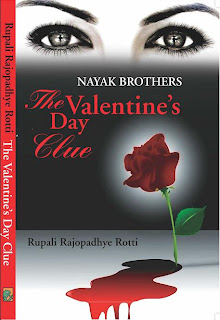
After working in the corporate world and running business, Rupali finally ventured into writing. Her first book, "The Valentine's Day Clue", has just been published under the series title: "Nayak Brothers". This is a detective adventure series that revolves around two aspiring detectives living out of Pune, India. Like any other teenager, they have dreamy eyes, fire in their bellies, friends they care about, and an urge to make a difference. And yet, they struggle with their daily routine, studies (!), self-doubt, coming-into-age woes, and inexperience. But along the way, a mystery and an adventure of a lifetime is in the offing...

Visit Rupali at her website or on Facebook.