Thursday, October 17, 2013

The Secret to Revisions? It’s….


  By Hank Phillippi Ryan


You type THE END. You stand and applaud yourself. And you should! You’ve crafted the crucial first line, and the all-important end of page three, and the big hook at the end of chapter one. Your book is still compelling after twenty pages, the middle is not bad, and the ending is kickass.

Yay, you!

But you are not finished. Now comes the good part. The difficult part! But the good part. 

Revisions. 

The good news and the bad news: it takes longer, much longer than you might think, to make your book wonderful.

I love revisions. After those months of panic and agony as I try to unearth the plot from the recesses of my brain, it’s a joy to have that big manuscript, all those nice words, in front of me, ready for me to carve it into the book I really meant to write. 

Revisions. 

How do you go through the whole darn thing and make it better? (If you’re me, how do you wrangle 120,000 words into 95,000?)

I have kind of a system. Works for me. 

First, I put the book away for a week. (It should be two weeks, but who has two weeks?)

Then I start reading it—but here’s the key. I read it as if I didn’t write it. I do that by pretending I’m someone else. You know how when you hit “send” to deliver a manuscript to your editor or reader? And as soon as you do, you think—darn. I need to change this. That’s because in that moment, you are reading it through someone else’s eyes.

Try it. Okay? Poof. You’re someone else. A tough reader, a smart reader, one who is seeing this thing for the very first time. Look at it as fun. As a challenge. Your goal is to help this poor writer be fabulous. 

Ah HA. Now you’ll see the plot holes. The repetition. The stilted dialogue. The scenes (you have scenes, right?) without any action. The pages without conflict. The parts you skip.  The weak verbs. “Was.” “Just.” “Suddenly.” The excessive description. The characters with no motivation. The coincidences. The wordiness. The repetition. (Oh, I said that.)

Choose a character and follow that person through your story. Are the motivations clear and understandable? The behavior consistent? Their language unique and identifiable?

Find your default words: how often did you write ‘of course’? Or ‘really’? Or ‘very’? We all have our favorites. And they all have to go. In one manuscript, I discovered I used “flickered” 23 times. Flickered! And twisted about as many times.

(And I start too many sentences with “and.”)

Are there scenes where nothing happens? Make sure every scene advances the story. A good thriller is all about action, right? So no BOGSAT. (Bunch of guys, sitting around talking.)

Are there scenes without cinematic setting?  If your book were a movie, would it be interesting? How can you amp up the mind pictures to make your book as visual as possible?

Fun, huh? No, really, it is. You’re not finding mistakes or proof you’re a terrible writer. The opposite! Every time you discover an error or tighten a sentence or pick a stronger verb—you win. It’s a treasure hunt with you as the winner. 

And revisions are when the magic happens. You’ll see---wow, I have a theme! How did that happen? You’ll see clues you dropped—without even knowing it. You’ll see your clever parallel construction, and foreshadowing and character development and humor—stuff you didn’t even know you were writing.  You’ll see how your brain has created a bigger story than you realized—and it’ll be a joy. 

Jump into those revisions. There’s a surprise around every corner. And when you finally finally type “The End” for real—it will be the beginning of something wonderful.

BIO:
HANK PHILLIPPI RYAN is the on-air investigative reporter for Boston’s NBC affiliate. She’s won 30 EMMYs, 12 Edward R. Murrow awards and dozens of other honors for her ground-breaking journalism.
A bestselling author of six mystery novels, Ryan has won multiple prestigious awards for her crime fiction: two Agathas,
the  Anthony, Macavity, and most recently, the coveted Mary Higgins Clark Award. National reviews have called her a "master at crafting suspenseful mysteries" and "a superb and gifted storyteller."Her newest thriller, THE WRONG GIRL, is a Boston Globe bestseller and was dubbed "Another winner" in a Booklist starred review. She’s on the national board of Mystery Writers of America and 2013 president of national Sisters in Crime. Visit her online at HankPhillippiRyan.com, on Twitter @hank_phillippi and Facebook/HankPhillippiRyanAuthorPage.

THE WRONG GIRL—Hank’s newest chilling and heart-wrenching novel of suspense—is a thrilling tale of dark secrets and frightening betrayal that strikes at the heart of every family. After her debut in THE OTHER WOMAN (nominated for the Agatha, Anthony, Shamus, Daphne and Macavity; winner of the Mary Higgins Clark Award), investigative reporter Jane Ryland now returns in THE WRONG GIRL--and this time she's on the trail of a frightening story that could rip families apart. Does a respected adoption agency have a frightening secret? Tipped off by a determined ex-colleague on a desperate quest to find her birth mother, Boston newspaper reporter Ryland begins to suspect that the agency is engaging in the ultimate betrayal--are they reuniting birth parents with the wrong children? 


For detective Jake Brogan and his partner, a young woman’s brutal murder seems a sadly predictable case of domestic violence, one that results in two toddlers being shuttled into the foster care system. Then Jake finds an empty cradle at the murder scene. Where is the baby who should have been sleeping there?

Jane and Jake are soon on a trail full of twists and turns that takes them deep into the heart of a foster care system in crisis and threatens to blow the lid off an adoption agency scandal. When the threatening phone calls start, Jane knows she is on the right track...but with both a killer at large and an infant missing, time is running out....

THE WRONG GIRL is a riveting novel of family connections—both known and unknown—vile greed, senseless murder, and the ultimate in deception. What if you didn’t know the truth about your own family?

(Watch for the new TRUTH BE TOLD in September 2014.)


Thursday, October 10, 2013

What it Takes


By Barry Lancet


It took me ages to write JAPANTOWN. 
So many times I could have stopped.  So many times friends and family expected me to stop.  Occasionally someone advised me to stop.  But I persisted and it paid off—Simon & Schuster published it, J. J. Abrams optioned it, and foreign rights sales are rising nicely. 
Someone came up to me the other day and said, “Boy, are you ever lucky.” 
I smiled and said thank you.   When I had a free moment, I thought about the comment.  Yes, I’ve been lucky.  And I’m grateful and humbled.  But it took so much more than luck.  
Hitting a Brick Wall
The barriers I faced may be one for the record books. 
Let’s start with this:  I’ve lived in Tokyo for more than twenty-five years.  When I began to write, my day job tied me down sixty to seventy hours a week, Monday through Saturday, without counting the one-hour commute each way. 
To say I was busy was an understatement.  For one thing, I was doing this in Tokyo.  For a Japanese company.  With a wife and two kids.  In any language, this translates as “no free time.” 
For another, I came home exhausted six nights a week.  Sometimes I brought work back with me.  My office routine was so demanding that early-morning or late-night writing sessions were not options.  Family time filled in the few hours of unscheduled time that remained. 
It soon became apparent that I had no time whatsoever to write other than the two days a week I ate lunch alone.  But two hours a week will not get a novel written.  I had to find time so I poured over my schedule. 
There was none to spare. 
The First Step
Eventually, it dawned on me that I would have to make time. 
So I limited my lunch outings with friends and colleges to two a week and then one.  That gave me four lunches to write.  Occasionally I was forced to drop this back to three, but for the most part it held.  Time gained: two hours a week. 
But it still wasn’t enough. 
I became more efficient at work.  I cut out all unnecessary “water cooler time.”  I delegated some lesser chores to other in-house staff and to competent freelancers.  Yes, it took extra time to train them at first, so in the initial stages I actually lost time.  But slowly, I chipped away at my office workload.  I began to finish earlier some nights, cutting off as much as an hour, then ninety minutes.  Eventually, I was able to consistently save sixty to ninety minutes, six days a week.  Time gained: six to nine hours a week. 
But it still wasn’t enough. 
I cut back on late-night outings with friends and colleagues.  I said no when I wanted to say yes.  I set strict time limits for myself when setting up work-related meetings.  No more leisurely three-hour huddles when one would do.  This belt-tightening freed up another three or four hours a week. 
Yet it still wasn’t enough. 
Digging Deeper
All the while I was writing.  My story grew.  Characters were born.  Chapters started to take shape. 
But I desperately needed more time.  I poured over my schedule once more. Every minute of the day was accounted for.  Then my eyes fell on the line that said “daily commute.”  This took an hour each way.  Fifteen minutes on foot, then forty-five minutes on the train—standing shoulder to shoulder squeezed in with all the other commuters.  I spent the time reading.   Was it possible to turn the rush-hour crush into working time?   I decided to give it shot. 
So the first week I packed my laptop.   When a seat opened up halfway through the commute two or three days a week, I whipped out my computer, fired it up, opened my files, found my place, then had ten minutes to work before the train pulled into the station and I had to reverse the process.  Lugging the portable around every day for an additional twenty or thirty minutes a week of writing time was not a solution.
Deeper Still
I was stymied.  Then I thought, clipboard.  I printed out some manuscript pages and affixed them to a clipboard bought for my newest foray.  As soon as I was on the train, I pulled out the board and began editing, rewriting, and adding new passages. 
The train swayed.  I held the board with my left hand, the commuter strap with my right.  More than once I bumped into a neighbor when I released the strap to write something and the train hit a rough patch.  One time the clipboard flew into the lap of the passenger seated in front of me, startling him and most likely making his first cup of caffeine at the office redundant. 
This was going to require a coordinated effort on many levels. 
I dug in.  Day after day, I wrote.  Each night I reviewed my efforts and dutifully discarded them.  They were all unusable.  I couldn’t find a rhythm.  I couldn’t concentrate with the crush, the noise, the jerking motion of the train.  Not only wasn’t I producing but I’d also lost my commute reading time, which I’d always enjoyed. 
But I persisted.  Eventually, I learned how to stand with the clipboard in a balanced manner, with both hands free.  I learned to sway with the train.  I learned where the rough patches of track were.  Toward the end of the third week I wrote one new passage that read passably well that evening and again the next morning.  By the following week I finished two acceptable rewrites. 
The learning curve took two months to complete, after which I was able to produce work every single day.  I’d found a mental and physical balance and learned to tune out all exterior factors.  My overall production soared.  With the extra lunch hours, the saved meeting times, the shorter daily workloads, and my commuter output, JAPANTOWN began to take shape.  I finished a full first draft, then a second.  Then a third.  Then a complete overhaul because I grew dissatisfied with the pacing.  
Then one day it was done. 
Because I’d found time where before I’d seen none. 
Yes, I’ve been lucky.  But it takes more.  What it takes is the desire to unearth what you’re lacking—whether it’s time, confidence, better skills, more knowledge, a combination of these, or something else entirely. 
So identify what you need, track it down, then plow ahead without looking back. 
That’s what it takes. 
THE BOOK—JAPANTOWN
Five bodies.  One clue.  Not a trace of the killer.
San Francisco antique dealer Jim Brodie recently inherited a stake in his father's Tokyo-based private investigation firm, which means the single father of six-year-old Jenny is living a bi-coastal life, traveling to Japan to acquire art and artifacts for his store and consulting on Brodie Security's caseload at home and abroad.
One night, an entire family is gunned down in San Francisco's bustling Japantown neighborhood, and Brodie is called on by the SFPD to decipher the lone clue left at the crime scene: a single Japanese character printed on a slip of paper, drenched in blood.
Brodie can't read the clue either. But he may have seen it before—at the scene of his wife's death in a house fire four years ago.
With his array of Asian connections and fluency in Japanese, Brodie sets out to solve a seemingly perfect crime and at the same time learn whether his wife's tragic death was more than just an accident.  
What he unearths shocks him.  Wishing to turn back but knowing the only way is forward, he focuses on the deadly secret that threatens not only his life—but also the lives of his entire circle of family and friends. 
Author photo by Ben Simmons
THE AUTHOR
Barry Lancet moved from California to Tokyo in his twenties, where he has lived for more than two decades.  He spent twenty-five years working for one of the country’s largest publishers, developing books on dozens of Japanese subjects from art to Zen—all in English and all distributed in the United States, Europe, and the rest of the world. 
His unique position gave him access to many inner circles in cultural, business, and traditional fields most outsiders are never granted.  Early in his tenure in the Japanese capital, he was hauled in by the police for a non-criminal infraction and interrogated for three hours, one of the most heated psychological encounters he had faced in Japan to that point.  The run-in fascinated him and sparked the idea for a thriller based on his growing number of unusual experiences in Japan.  He is now at work on his next book featuring Jim Brodie. 
JAPANTOWN, his debut novel, has been optioned by J. J. Abrams’ Bad Robot Productions, in conjunction with Warner Bros.  For more information, please visit http://barrylancet.com/. 

Thursday, October 3, 2013

October Debut Releases

It's the first Thursday in October and that means new debut releases. 

Please take a look and let’s celebrate their success!


Susan Klaus - Secretariat Reborn (Oceanview Publishing) October 1, 2013

Christian Roberts, lanky, blond, and twenty-five-years-old, rents out small sailboats on Sarasota Bay. His peaceful life is shattered when he accepts a thoroughbred colt from his estranged, dying father, an Ocala horse trainer. When Christian promises his father that he'll race the colt, he's plunged into the underworld of horse racing. To navigate his way he naively hires Ed Price, a heartless Miami trainer. And when his colt shows potential -- a surprising resemblance to Secretariat -- a dubious wealthy sheik wants to buy him, but Christian vows to keep his promise to his father. 

With a sizable debt still owed on the horse, Christian is forced to take out a loan, his only recourse, Vince, a New York mobster. If the money is not repaid on time, Christian's life and that of Allie, his colt's trainer, are threatened. To add to his rollercoaster of troubles, he faces fraud charges since his father illegally registered the colt, and he is being stalked by a psychotic ex-girlfriend. Can Christian and Allie overcome the tornado of adversity and forge a relationship with each other and the colt?


Matthew Quinn Martin - Nightlife (Pocket Star) October 21, 2013


For centuries an ancient evil has slept beneath the streets of New Harbor. This Halloween, it wakes up.

An action-packed debut horror novel from talented new writer Matthew Quinn Martin, Nightlife pits a feisty bartender and a mysterious loner against bloodthirsty terrors as alluring as they are deadly.

Nightclub bartender and serial heartbreaker Beth Becker might be a cynic. But when her best friend goes missing Halloween night, Beth knows it’s up to her to find out what happened.

Her quest will take her on an odyssey through the crumbling city of New Harbor, Connecticut. Along the way she meets a homeless prophet warning of something he calls the “Night Angel”—a bloodthirsty creature that feeds on the forgotten. And she will form an unlikely bond with a hunted stranger who knows all too well what stalks the streets at night.

He tells Beth the hideous truth about the nightmare creatures that have haunted mankind’s imagination for eons—creatures the world calls vampires. Together they are the only hope for New Harbor, but to defeat what lurks in the shadows they’ll have to conquer something far stronger than fear—their own desires.


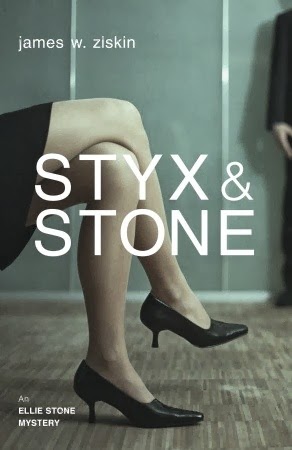
James W. Ziskin - Styx & Stone (Seventh Street Books) October 15, 2013

Ellie Stone is a professed modern girl in 1960s’ New York City, playing by her own rules and breaking boundaries while searching for a killer.
“If you were a man, you’d make a good detective.”
Ellie Stone is sure that Sgt. McKeever meant that as a compliment, but that identity-a girl wanting to do a man’s job-has throttled her for too long. It’s 1960, and Ellie doesn’t want to blaze any trails for women; she just wants to be a reporter, one who doesn’t need to swat hands off her behind at every turn.
Adrift in her career, Ellie is back in New York City after receiving news that her estranged father, a renowned Dante scholar and distinguished professor, is near death after a savage bludgeoning in his home. The police suspect a routine burglary, but Ellie has her doubts. When a second attempt is made on her father’s life, in the form of an “accident” in the hospital’s ICU, Ellie’s suspicions are confirmed.
Then another professor is found dead, and Ellie’s investigation turns to her father’s university colleagues, their ambitions, jealousies, and secret lives. Ellie embarks on a thorny journey of discovery and reconciliation, as she pursues an investigation that offers her both a chance at redemption in her father’s eyes, and the risk of losing him forever.


Thursday, September 26, 2013

Top Ten Tips for Debut Authors

By John Clement

I won’t bore you with a lengthy essay on how the world of publishing can feel like a vast, unknowable, and terrifying behemoth to a debut author. 

I figure if you’re reading this there’s a pretty good chance you’ve already figured that out. Instead, I’ll take this opportunity to share the knowledge I’ve acquired in my one-and-a-half year career as a published author. 

I’m using the “Top Ten” format to make everything as concise and helpful as possible, but I should point out right off the bat that there may not be enough knowledge to make it all the way to #10. Let’s find out, shall we?

#1. Don’t Write Top Ten Lists.
I’m told Top Ten lists are much more likely to get quoted and shared and emailed around the Internet, thereby reaching more readers (and thus more book-buyers), but a Google search of the phrase “Top Ten List” produces a catalog of roughly 1,700,000,000 entries. Try to be more original. For example, a Google search for “Top Three and 1/2 List” gets zero results. Write a Top Three and 1/2 List and you’ll stand out like a sore thumb. You’re welcome.

#2. Writer’s Conferences. Go to them.  
If, like me, you don’t enjoy conferences or big crowds of people in general, go to them anyway. I prefer small groups of people. Three is ideal, four is pushing it. Plus I have a bad case of (self-diagnosed) Central Auditory Processing Disorder, a physical and/or neurological and/or psychological impairment that affects the ear, whose job it is to separate essential sound from background noise and deliver only the essential sound to the intellectual center of the brain. 

Although I’m not altogether certain my brain has an intellectual center, I do know that I go into overload whenever I’m in a room filled with talking people. A writer’s conference is essentially a room filled with talking people, but I’ve attended three conferences so far, and I can say without hesitation that writers, and in particular, mystery writers, are the most helpful, supportive and generous people in the world. You’d be amazed how much encouragement and inspiration you can get from talking to other writers, and you’ll make great friends.

#3. Don’t read reviews of your book.
No matter how tempting. Not even the good ones. There’s no better way to fuck up your inner voice than to let other voices in. I curse because I mean it.

#3 1/2. Don't spend too much time reading blogs about writing and the publishing industry.
(Or, for that matter, playing online Scrabble with Facebook friends from high school). It's accepted wisdom that your second book will be harder to write than your first. I learned that at a conference and it's true. So don't sweat it. Just close your web browser and go write for a while.


BIO:

John Clement is the author of the popular Dixie Hemingway Mystery Series created by his mother, writer Blaize Clement (1932-2011). The eighth book in the series, The Cat Sitter’s Cradle (2013 St. Martins/Minotaur) received unanimous praise from fans and critics alike. The Cat Sitter’s Nine Lives will appear July, 2014. John lives in New York City, where he’s currently working on the 10th book in the series.


THE CAT SITTER'S CRADLE: Blaize Clement won fans all over the world with the charm and wit of her pet-sitting mysteries. Now, with the help of her son, author John Clement, Blaize’s beloved heroine Dixie Hemingway is back for yet another thrilling adventure in this critically-acclaimed series.
Dixie has built a nice, quiet life for herself in the sleepy town of Siesta Key, a sandy resort island off the coast of Florida.
In fact, her pet-sitting business is going so well she’s even taken on part-time

help: Kenny, a handsome young surfer who lives alone in a rickety old houseboat. Things get a little messy, however, when on an early morning walk in the park with a client’s schnauzer, Dixie makes a shocking discovery. Hidden among the leafy brambles is a homeless girl, alone and afraid, cradling a newborn baby in her arms.

Dixie takes the young girl under her wing, even though she’s just been hired by Roy Harwick, the snarky executive of a multi-national oil and manufacturing company, to care for his equally snarky Siamese cat, Charlotte, along with his wife’s priceless collection of rare tropical fish. It’s not long before Dixie stumbles upon a dead body in the unlikeliest of places, and soon she’s set adrift in a murky and dangerous world in which no one is who they appear to be.

Smart, fast-paced and entertaining, The Cat Sitter’s Cradle is a perfect illustration of why Dixie’s loyal fans have come to know and love her and eagerly await the next installment of her adventures.