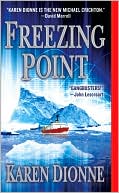
by Karen Dionne
I don't mean DaVinci Code or Harry Potter change, though there's no denying those novels' influence. They've redefined the term "blockbuster," spawned countless knock-offs, created a new sub-genre, even added words to the popular lexicon.
I'm also not referring to Booker or Pulitzer Prize-winning fiction destined to be discussed and dissected by literature students for decades.
I'm talking real-world change. The kind of change that affects people's lives in demonstrable, tangible ways. Meaningful, food-on-the table change that addresses a critical and very real global problem, such as the lack of clean drinking water.

Contaminated drinking water is the issue at the heart of my environmental thriller Freezing Point. The story features a concerned environmentalist who thinks he can alleviate the world's fresh water crisis by melting Antarctic icebergs into drinking water. Instead, his lack of understanding of the polar environment coupled with corporate greed creates an even bigger problem that ultimately threatens the entire planet.
Disillusioned, he abandons the corporate world and goes to work for the WaterLife Foundation, a non-profit organization that focuses on providing clean water and sanitation for underserved communities around the world.
The novel, of course, is fiction. But the WaterLife Foundation is real. In my author's notes, I direct readers toward this worthy non-profit. I discovered the organization while researching the novel, and was particularly taken with the way WaterLife targets villages and peri-urban communities with chronic water and sanitation issues - areas that are overlooked by emergency aid organizations because they're not experiencing a catastrophic situation, yet which actually represent the greatest need.
A typical WaterLife project is the one in Bapa, Camaroon, which includes a rehabilitated well, pump, and water reservoir for a health center serving 3,500 people.
3,500 might seem a drop in the bucket compared to the suffering billions. But these aren't just statistics, these are people: 3,500 very real people with hopes and dreams of long life and health and happiness - and the right to basic human services most of us take for granted.
Likewise, compared to hardworking environmental groups and documentaries like An Inconvenient Truth, my novel's potential for social change is small. And the story wasn't written to educate; it was written to entertain.
Yet all writers hope their words will make a difference. If my readers come away with a greater understanding of the world's water crisis and are moved to action, the story's reach might - just might - extend beyond the page. A reviewer observed that Freezing Point's "ingenious plot, genuine characters, superlative writing and nail-biting suspense will change the way you look at a bottle of water." Another said, "The storyline is chilling, and the reader can't help but become educated about the earth's fresh water resources."
Earth's fresh water situation is critical. Uneven distribution, pollution, abuse of the aquifer - serious scientists around the globe are sounding the warning. By incorporating their concerns into the storyline, I hope my novel shines a small spotlight on a very big problem.
For more about the WaterLife Foundation, visit www.waterlife.org.
Also see Michael Specter's analysis of the global water crisis "The Last Drop," as published in The New Yorker, October 23, 2006
Photo by Antony Funnell / AusAID
This essay originally appeared on The Huffington Post