Showing posts with label new author. Show all posts

Thursday, November 7, 2013

November Debut Releases

It's the first Thursday in November and that means new debut releases. 

Please take a look and let’s celebrate their success!


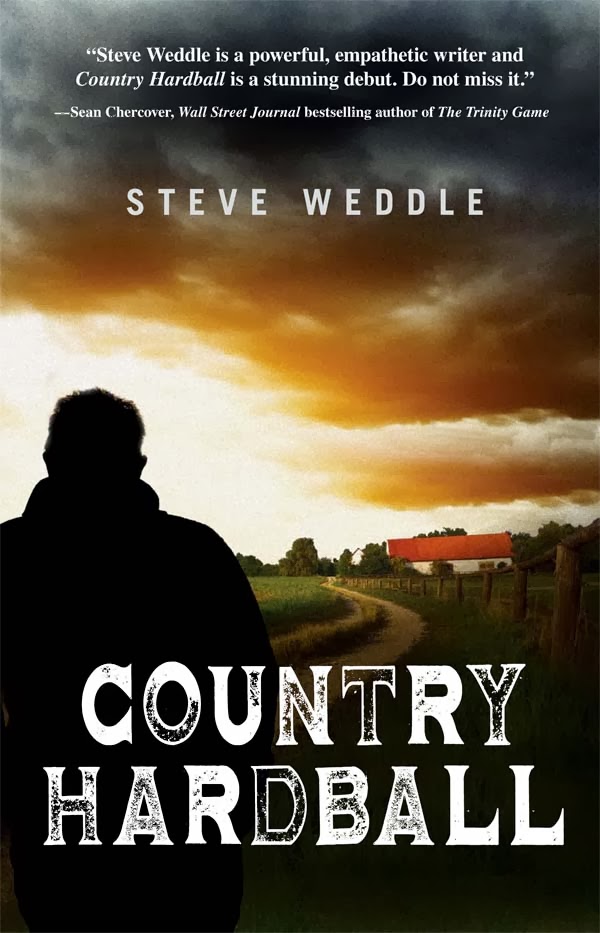
Steve Weddle - Country Hardball (Tyrus Books) November 18, 2013

After more than a decade spent in and out of juvenile detention, halfway houses, and jail, Roy Alison returns to his rural hometown determined to do better, to be better. But what he finds is a working-class community devastated by the economic downturn--a town without anything to hold onto but the past.
Staying with his grandmother, Roy discovers a family history of good intentions and bad choices, of making do without much chance of doing better. Around him, families lose their sons to war, hunting accidents, drugs. And Roy, along with the town, falls into old patterns established generations ago.
A novel-in-stories in the tradition of Bonnie Jo Campbell, Donald Ray Pollock, Denis Johnson, and Alan Heathcock, Country Hardball is a powerfully observed and devastatingly understated portrait of the American working class.
"Steve Weddle's Country Hardball is a perfect combination of the brokenhearted and the just flat broke... Here's hoping Weddle never stops writing..." --Benjamin Whitmer, author of Pike


Ed Aymar – I'll Sleep When You're Dead (Black Opal Books) November 16,2013
www.eaymar.com

Tom Starks has spent the three years since his wife’s murder struggling to single-handedly raise their daughter, Julie, while haunted by memories of his dead spouse. When he learns that the man accused of her murder, Chris Taylor, has been released from prison, Tom hires a pair of hit men to get his revenge. But when the hit men botch the assassination, Tom is inadvertently pulled into their violent world.

And now those hit men are after him and his daughter.

I'll Sleep When You're Dead is a haunting tale of vengeance and its toll. It is both thrilling and tender...E.A. Aymar weaves a touching tapestry loaded with surprises.”
- Michael Sears, author of Black Fridays, winner of the Shamus Award for Best First Novel

Thursday, May 16, 2013

Advice to Newcomer Authors

By Heather Graham

My first piece of advice to any newcomer is to take my advice if it works for you—and ignore it if it doesn’t.
 

I haven’t given any yet, not really. 

So here it is. 

We go to all kinds of workshops and panels and we hear how many experts work. I should qualify what I’m saying. If an FBI agent tells you something that an FBI agent would do, I’d go with it. Or if an arms specialist told me about a gun, I’d go by what he says.

But we read subjectively and have different pet peeves and the way we write can be just as subjective. Story boards are great and you can go to wonderful workshops on them; for some people, it’s easier to keep notes, or even immerse themselves in their manuscripts. Some will tell you that you need an outline to get started while other authors like to sit down and go and see where their characters and words lead them.

But if you’re ever in a workshop and someone—even someone who is extremely successful—tells you that you must work in one way or another, that someone just might be wrong. There are authors who will tell you that they must have certain music playing; they must have coffee at hand, or that they must set the mood. They must be alone—they can only concentrate in perfect silence. 

You may not like the distraction of music. You might not mind the chaos of working in the middle of Grand Central Station—or your house, which just might feel and sound like Grand Central Station at times. 

We all work differently.
So, there really is no right way to go about writing. 

I’ve seen authors go to conferences and hear conflicting advice or believing that they have to take every piece of advice or adhere to everything they’ve learned. Now, most of the time, the person speaking is going to give great advice. And most of it will be valuable. The writer (and the “old” writer) must listen and learn and then create a filter. Everything that is useful to them needs to be held and what just won’t work in their methods or their lives, they have to let go. 

Trying to take every piece of advice is like trying to please every single reader out there—it’s not going to happen.

This goes back to where your friends/critique partners or even editors that read your work. One may love a protagonist and hate a plot twist. Loathe one character and become annoyed by another. Some have an instant dislike of first person or present tense. 

A writer has to use his or her own filters or be lost in a jumble of confusion. Study your own work—decide what you feel. Often a writer will realize that a character who shouldn’t be is abrasive. Or there is a hole in the plot that a truck could drive through. Listen, learn—and be honest and a little brutal with yourself—and weigh every piece of what you’ve heard with your belief in yourself, your book, your characters, and your plot. 

Remember, too, your mother/best friend/husband/sister can’t buy your book. An editor can, so if an editor suggests something you’re not sure about, you really might want to make the changes.
(Unless your mother/best friend/husband/sister/etc. happens to be an editor!

If these words are helpful to you, use them. If not, please filter out! 


BIO: New York Times and USA Today best selling author, Heather Graham, majored in theater arts at the University of South Florida. After a stint of several years in dinner theater, back-up vocals, and bartending, she stayed home after the birth of her third child and began to write. Her first book was with Dell, and since then, she has written over one hundred novels and novellas including category, suspense, historical romance, vampire fiction, time travel, occult and Christmas family fare.
She is pleased to have been published in approximately twenty languages. She has written over 100 novels and has 60 million books in print. She has been honored with awards from Walden Books, B. Dalton, Georgia Romance Writers, Affaire de Coeur, Romantic Times and more. 
Heather has also become the proud recipient of the Silver Bullet from Thriller Writers. Heather has had books selected for the Doubleday Book Club and the Literary Guild, and has been quoted, interviewed, or featured in such publications as The Nation, Redbook, Mystery Book Club, People and USA Today and appeared on many newscasts including Today, Entertainment Tonight and local television. 
Heather loves travel and anything that has to do with the water, and is a certified scuba diver. She also loves ballroom dancing. Each year she hosts the Vampire Ball and Dinner theater at the RT convention raising money for the Pediatric Aids Society and in 2006 she hosted the first Writers for New Orleans Workshop to benefit the stricken gulf region.  
She is also the founder of “The Slush Pile Players”, presenting something that’s almost like entertainment for various conferences and benefits. Married since high school graduation and the
mother of five, her greatest love in life remains her family, but she also believes her career has been an incredible gift, and she is grateful every day to be doing something that she loves so very much for a living. 
The Unseen, The Unholy, The Unspoken and the Uninvited are available now.  Let the Dead Sleep will be released in March, 2013.  The Night is Watching,  The Night is Alive and The Night is Forever will be released in June, August and October.

Visit Heather at her website and blog.

Thursday, April 11, 2013

Going Pro by NY Times bestelling author Jonathan Maberry


When I was a newbie writer, before I was established or even professionally published I used to believe that ‘the writing life’ was exactly how I saw it on TV or in movies. You know, where the author is a tortured artist who craves a midnight visit from the muse; then he gets drunk, strips to his wife-beater undershirt, and hammers out an incredible book that leaps to the top of the bestseller list. His agent and editors treat him like royalty and he buys a big house, a sports car, and is the darling of the social scene.

Then I became an author. I won some awards, had some bestsellers, even wound up on TV.

But, kiddo, the real world ain’t like it is in the movies.

Shocker, I know.

The truth is, however, more interesting because it’s more real.

First and most important thing to know is that, while writing is an art, publishing is a business. Writing is an intimate conversation between author and reader; even if it’s a conversation repeated many times with many readers. Both writer and reader are there for the story, for the art.

Publishing is about selling copies of art. It’s not about art itself. If you grasp that truth, if you understand it and accept the reality and practicality of it, then you won’t get your feelings hurt. And you’ll probably do better as a working writer.

It’s not that everyone in publishing is a cold and heartless whore. That’s as propagandized a view as the movie version of author as tortured artist. The individual people in publishing–from agents to editors, from book salesmen to booksellers—may have been drawn to their vocation out of a love of books. But their job is to sell them. 

They are not the enemy, as many writers seem to think. They are not backstabbing cheats, as too many frustrated writers suggest in their blogs. They are in a business whose product is copies of written works. To accomplish this end, they need to make decisions about whom to publish, how many copies and in what format to publish, who to promote, and who to gamble on. Viewed from a distance, there’s no villainy. They are not trying to hurt the feelings or stifle the career of fledgling writers.

Are they always right?  Of course not. If anyone actually knew the absolutely right way to publish every book so it would be a guaranteed hit, we’d all be gazillionaires. Like any business it’s largely trial and error, learn from experience, guesswork and statistics.

It is not, however, about art. It’s not about supporting the artist.  It’s not about making guarantees that each work will be successful. That business model does not, and could not, exist.

Given this, it’s important for all writers–especially newbies—to work with the system. Doing so does not require that you sacrifice even a drop of your artistic integrity. It does, however, require that you step away from the propaganda and mythology about being an artiste and act like a professional, working writer.

That doorway opens onto success.

  ********* 


EXTINCTION MACHINE by Jonathan Maberry (St. Martin’s Griffin) The President of the United States vanishes from the White House. A top-secret prototype stealth fighter is destroyed during a test flight.  Witnesses on the ground say that it was shot down by a craft that immediately vanished at impossible speeds. All over the world reports of UFOs are increasing at an alarming rate. And in a remote fossil dig in China dinosaur hunters have found something that is definitely not of this earth. There are rumors of alien-human hybrids living among us. Joe Ledger and the Department of Military Sciences  rush headlong into the heat of the world’s strangest and deadliest arms race, because the global race to recover and retro-engineer alien technologies has just hit a snag. Someone—or somethingwants that technology back.


BIO
Jonathan Maberry is a NY Times bestselling author, multiple Bram Stoker Award winner, and freelancer for Marvel Comics. His novels include EXTINCTION MACHINE, FIRE & ASH, PATIENT ZERO and many others. His award-winning teen novel, ROT & RUIN, is now in development for film. He is the editor of V-WARS, an award-winning vampire anthology. Since 1978 he’s sold more than 1200 magazine feature articles, 3000 columns, plays, greeting cards, song lyrics, and poetry. He is the founder of the Writers Coffeehouse, and co-founder of The Liars Club. Jonathan lives in Bucks County, Pennsylvania with his wife, Sara Jo. www.jonathanmaberry.com